
The Florida Pool Cage Inspection Report: What Homeowners Are Most Surprised to Learn About Their Enclosure
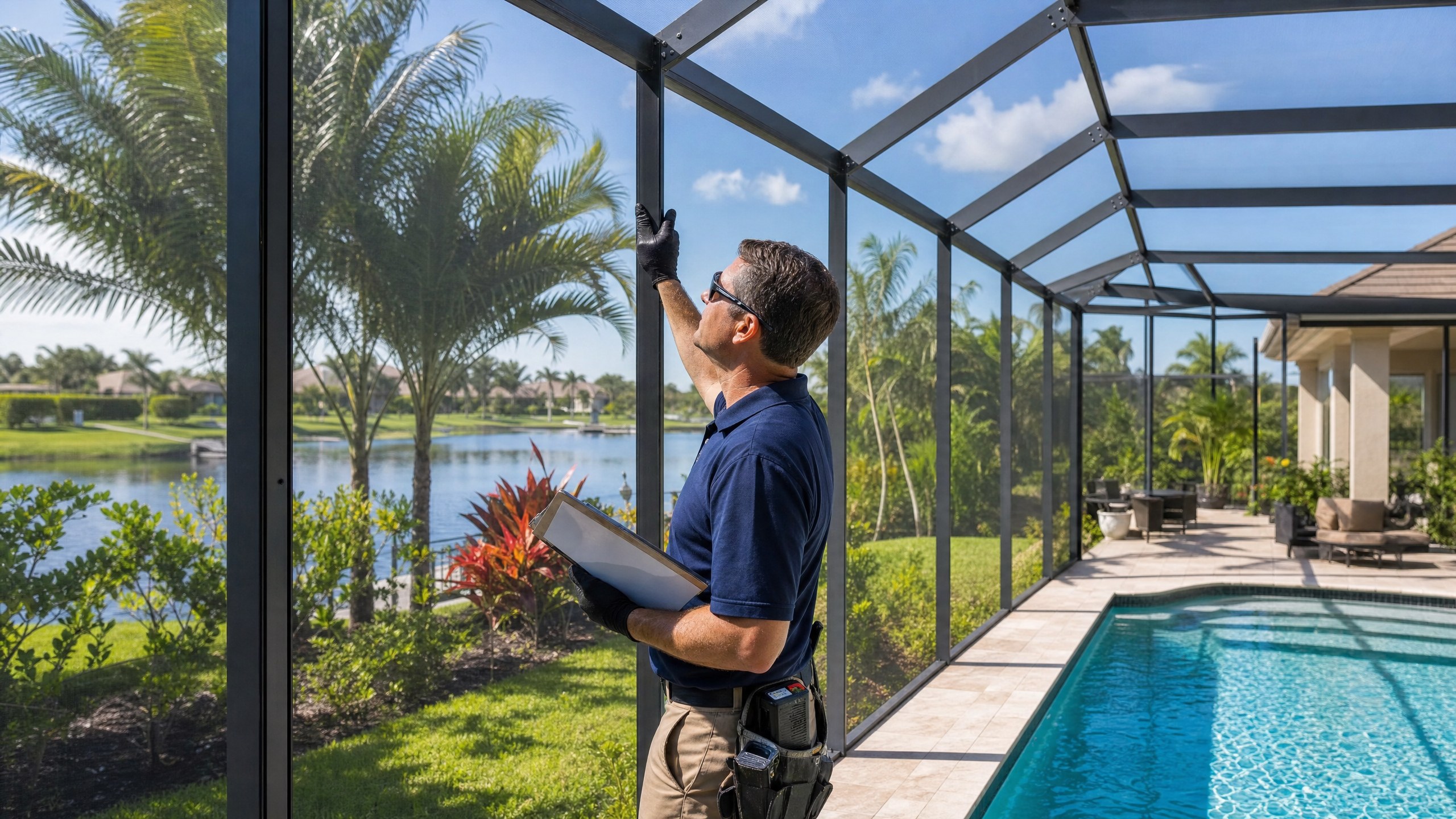
By Gian Nicolo, Owner
One of my favorite moments during a pool cage inspection happens at the very end.
Not because the inspection is finished.
Not because we’re discussing recommendations.
Because that’s usually when the homeowner says:
“I had no idea.”
After years of evaluating pool enclosures throughout Florida, I’ve learned that homeowners are often surprised by the same things over and over again.
Not because they’re uninformed.
Because many of the most important aspects of a pool enclosure are hidden.
Most people see:
- Screens
- Paint
- Doors
- Aluminum
What they don’t see are:
- Connection systems
- Structural loads
- Fastener conditions
- Corrosion development
- Long-term deterioration patterns
That’s where the surprises usually begin.
This article covers the things homeowners are most shocked to learn during professional pool cage inspections.
Surprise #1: The Screen Is Often the Least Expensive Problem
Most homeowners call because of torn screens.
It’s understandable.
Screen damage is visible.
It attracts attention immediately.
But during many inspections, the torn screen isn’t actually the issue that concerns me most.
The larger concerns are often:
- Corrosion
- Fasteners
- Structural movement
- Deferred maintenance
The screen is simply the thing that got the homeowner’s attention.
The inspection reveals everything else.
Read full rescreening vs panel replacement.
Surprise #2: Rust Stains Are Usually a Symptom
Homeowners frequently point to rust stains and ask:
“Can you paint over that?”
The answer is usually:
“Maybe.”
But that’s not the important question.
The important question is:
“What caused the stain?”
The stain itself is rarely the problem.
It’s evidence.
Evidence that something above the stain is deteriorating.
Until the source is understood, no real solution exists.
This is one of the biggest misunderstandings in the industry.
See the fastener problem most Florida pool cage owners don’t know about.
Surprise #3: Doors Reveal More Than Almost Anything Else
Homeowners are often amazed by how much information a door provides.
A sticking door may indicate:
- Structural movement
- Connection changes
- Settlement
- Storm-related stress
Most people assume they have a hardware issue.
Sometimes they do.
But many times the door is simply reporting changes elsewhere in the enclosure.
This is why experienced inspectors pay close attention to door performance.
Read when pool enclosure doors sag, stick, or won’t close.
Surprise #4: The Pool Cage May Be Older Than the Homeowner Thinks
This happens more often than people realize.
Properties change hands.
Records get lost.
Repairs happen.
Modifications occur.
Many homeowners aren’t entirely sure:
- When the enclosure was built
- What repairs were performed
- Whether restoration has occurred
- What materials were used
Part of the inspection process often involves reconstructing the enclosure’s history.
Because history helps predict future performance.
See why some Florida pool cages age faster than others.
Surprise #5: The Biggest Problems Are Usually Hidden
This may be the most important point in the entire article.
The biggest concerns we discover are often invisible from the patio.
Examples include:
- Fastener deterioration
- Hidden corrosion
- Connection issues
- Structural stress
Homeowners are often shocked because the enclosure looked fine.
That’s exactly why inspections matter.
The most expensive problems are rarely the most visible ones.
Read the hidden problems found on most pool cage inspections and what most contractors miss during an inspection.
Surprise #6: A Pool Cage Can Survive a Hurricane and Still Be Damaged
This is one of the most common misunderstandings in Florida.
The enclosure survived.
Therefore everything must be okay.
Not necessarily.
Storms can create:
- Connection stress
- Structural movement
- Hidden damage
- Accelerated deterioration
The cage may remain standing while still requiring attention.
Survival and performance are not always the same thing.
Surprise #7: Corrosion Doesn’t Care What the Enclosure Looks Like
Some of the most beautiful enclosures we inspect have corrosion.
Some of the ugliest enclosures have very little.
Appearance and condition are not the same thing.
This surprises homeowners constantly.
They assume visual appearance tells the whole story.
It rarely does.
Surprise #8: Many Pool Cages Need Restoration Earlier Than Homeowners Expect
Most people think restoration begins when the enclosure looks terrible.
The smartest restoration projects often happen much earlier.
Why?
Because restoration is often most effective before deterioration becomes severe.
Waiting too long usually reduces options.
This is one reason proactive homeowners often spend less money over time.
Read how much pool cage restoration costs in Florida.
Surprise #9: Fasteners Matter More Than Screens
This is probably the biggest surprise of all.
Most homeowners focus heavily on screen.
Professionals focus heavily on connections.
Why?
Because screen affects appearance.
Connections affect performance.
Both matter.
But only one is holding the enclosure together.
The homeowners who understand this usually start viewing their pool cage very differently.
Surprise #10: Most Problems Started Years Earlier
One of the hardest things for homeowners to understand is that today’s problem often began years ago.
Corrosion develops gradually.
Fasteners deteriorate gradually.
Structural stress develops gradually.
By the time visible symptoms appear, the process may have been underway for a very long time.
This is why inspections create so much value.
They identify problems earlier in the process.
Run a 5-minute pool cage inspection between professional evaluations.
The Most Common Statement We Hear
After a thorough inspection, homeowners often say:
“I never would have noticed that.”
That’s normal.
Most homeowners aren’t expected to notice it.
That’s why inspections exist.
The purpose isn’t finding problems.
The purpose is understanding the enclosure.
What a Good Inspection Should Do
A proper inspection should answer:
- What condition is the enclosure in?
- What concerns exist?
- What should be monitored?
- What should be repaired?
- What can wait?
- What provides the best value?
Without those answers, homeowners are often making decisions with incomplete information.
Before hiring anyone, use 25 questions every homeowner should ask a pool cage contractor.
Final Thoughts
Pool cage inspections are rarely about discovering catastrophic failures.
They’re about understanding reality.
The reality of:
- Structural condition
- Corrosion
- Fasteners
- Maintenance needs
- Future risks
The most valuable inspections aren’t the ones that find major problems.
They’re the ones that prevent major problems from ever developing.
And that’s why homeowners are often surprised by what they learn.
Because the most important parts of a pool enclosure are usually the parts they’ve never been shown before.
Call 727-645-9575 or book online.
Need Pool Cage Repair in East Lake? Call 727-645-9575 or book a free estimate online .