
Why Your Pool Cage Looks Chalky and White: The Truth About Oxidation in Florida
By Gian Nicolo, Owner
One of the most common questions homeowners ask when I arrive for an inspection is:
“Why does my pool cage look white?”
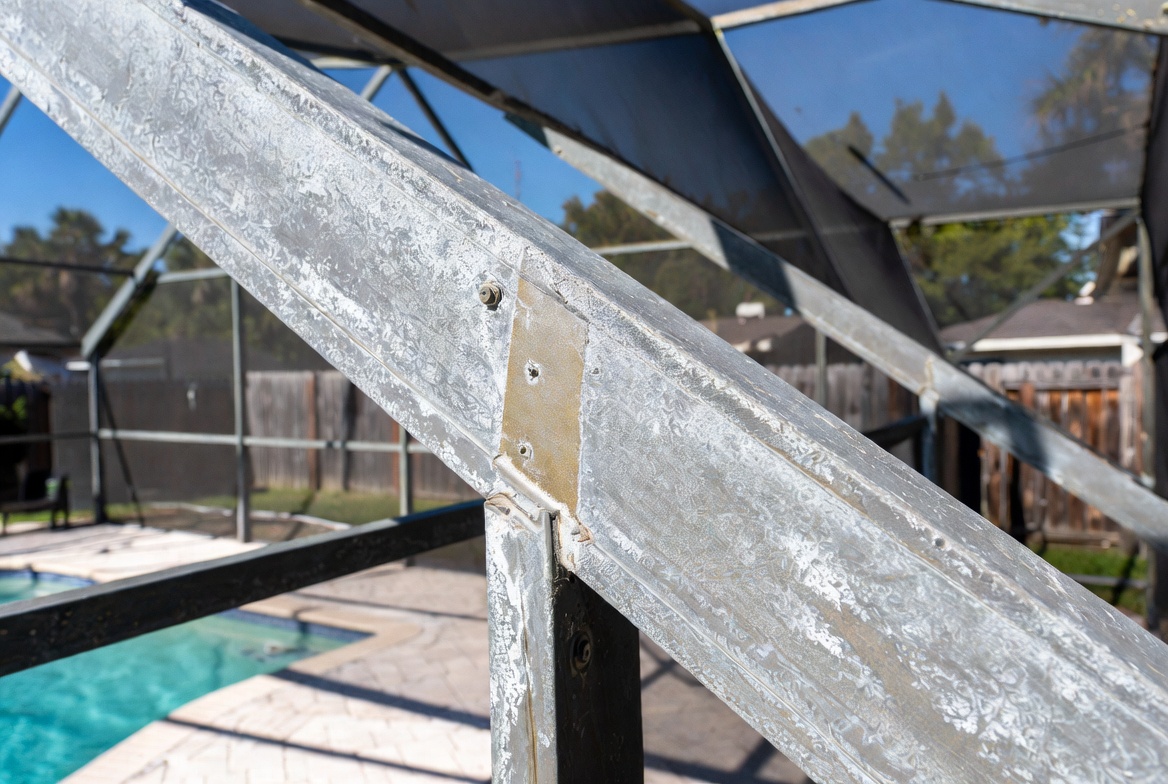
Sometimes they’ll rub their hand across the aluminum and show me the powder left on their fingers.
Other times they’ll point to faded beams and say:
“It used to be bronze.”
Or:
“It used to be white.”
Or:
“It never looked this bad before.”
The answer is usually the same.
Oxidation.
And if you own a pool enclosure in Florida long enough, oxidation is something you’re almost guaranteed to encounter.
The good news?
It’s common.
The bad news?
Most homeowners misunderstand what it means.
And because they misunderstand it, they often wait too long before doing anything about it.
What Is Pool Cage Oxidation?
Let’s start with the basics.
Oxidation is the gradual breakdown of the protective finish on the aluminum.
Over time, exposure to:
- UV radiation
- Humidity
- Rain
- Salt air
- Environmental contaminants
causes the surface coating to deteriorate.
As that happens, the enclosure begins developing the familiar chalky appearance that many Florida homeowners recognize immediately.
The white residue isn’t dirt.
It isn’t mold.
It isn’t mildew.
It’s the enclosure itself breaking down at the surface level.
Why Florida Accelerates Oxidation
Florida is one of the harshest environments in America for aluminum structures.
Think about what your enclosure experiences every year.
Intense UV Exposure
The Florida sun is relentless.
Unlike many states, there is very little seasonal relief.
The enclosure receives direct sunlight year after year.
Humidity
Moisture accelerates deterioration.
And Florida has plenty of it.
Salt Air
Even homes miles from the Gulf Coast experience airborne salt exposure.
Rain
Constant wetting and drying cycles affect coatings over time.
The result is predictable.
Every enclosure eventually begins showing signs of age.
The question is simply how quickly.
See why some Florida pool cages age faster than others.
The First Sign Most Homeowners Notice
Most people don’t notice oxidation visually at first.
They notice it physically.
They touch the enclosure.
Their hand comes away covered in a white powder.
That powder is usually the first warning sign.
The enclosure is telling you something.
The protective finish is deteriorating.
At this stage, many homeowners still believe the issue is cosmetic.
Sometimes it is.
Sometimes it isn’t.
Why Oxidation Matters
This is where many homeowners get confused.
Oxidation itself is often cosmetic.
But it tells us something important.
It tells us the enclosure is aging.
It tells us the protective finish is breaking down.
It tells us environmental exposure is taking its toll.
Think of oxidation as a warning light.
The warning light isn’t the problem.
It’s simply telling you something deserves attention.
Read the pool cage problem nobody sees coming.
The Biggest Oxidation Myth
The biggest myth is:
“It’s only cosmetic.”
Maybe.
Maybe not.
Heavy oxidation often makes it difficult to evaluate:
- Surface condition
- Corrosion development
- Fastener areas
- Long-term restoration needs
The more advanced the oxidation becomes, the more difficult restoration planning can be.
That’s why early evaluation often creates better outcomes.
See can my pool cage be restored or replaced.
Why Some Pool Cages Oxidize Faster Than Others
One of the most common homeowner questions is:
“My neighbor’s cage looks fine. Why does mine look terrible?”
Good question.
Several factors influence oxidation rates.
Sun Exposure
South-facing structures often age differently than shaded structures.
Coastal Exposure
Salt air matters.
A lot.
Maintenance History
Regular cleaning helps.
Age
Older finishes naturally deteriorate over time.
Original Finish Quality
Not all finishes age the same way.
This is why two seemingly identical pool cages may look dramatically different after ten years.
What Homeowners Usually Do Wrong
Most homeowners ignore oxidation for years.
Why?
Because the enclosure still functions.
The screens work.
The doors work.
Nothing feels urgent.
The problem is that oxidation rarely improves.
It usually progresses.
The earlier homeowners evaluate the condition of the enclosure, the more options typically exist.
Read the cost of waiting too long to restore a pool cage.
The Difference Between Oxidation and Corrosion
This distinction is important.
Many homeowners use the terms interchangeably.
They are not the same thing.
Oxidation
Usually affects the surface finish.
Corrosion
May affect structural components and fasteners.
One is primarily an appearance issue.
The other may affect performance.
This is why inspections matter.
The homeowner sees fading.
The inspector evaluates what is happening underneath.
See the fastener problem most Florida pool cage owners don’t know about and the hidden problems found on most pool cage inspections.
When Should Homeowners Start Paying Attention?
Immediately.
That doesn’t mean panic.
It means awareness.
The earlier oxidation is identified:
- The easier restoration planning becomes.
- The more information homeowners have.
- The more options typically exist.
Waiting rarely improves the situation.
Why Restoration Often Starts With Oxidation
Many restoration projects begin because of appearance.
The homeowner simply wants the enclosure to look better.
Nothing wrong with that.
But the evaluation process often reveals much more.
Including:
- Fastener condition
- Structural health
- Corrosion concerns
- Maintenance opportunities
The oxidation starts the conversation.
The inspection tells the real story.
Read how much pool cage restoration costs in Florida and the single most important question before restoring a pool cage.
Final Thoughts
Every Florida pool cage ages.
Every pool cage faces environmental exposure.
And eventually, most pool cages begin showing signs of oxidation.
The white chalky appearance isn’t unusual.
It’s one of the most common conditions we see.
The important thing isn’t whether oxidation exists.
The important thing is understanding what it means.
Because oxidation isn’t simply about appearance.
It’s information.
And homeowners who understand that information usually make better decisions about maintenance, restoration, and long-term ownership.
The enclosure is telling a story.
The question is whether anyone is listening.
Before hiring anyone, use 25 questions every homeowner should ask a pool cage contractor.
Call 727-645-9575 or book online.
Need Pool Cage Restoration in Tarpon Springs? Call 727-645-9575 or book a free estimate online .